
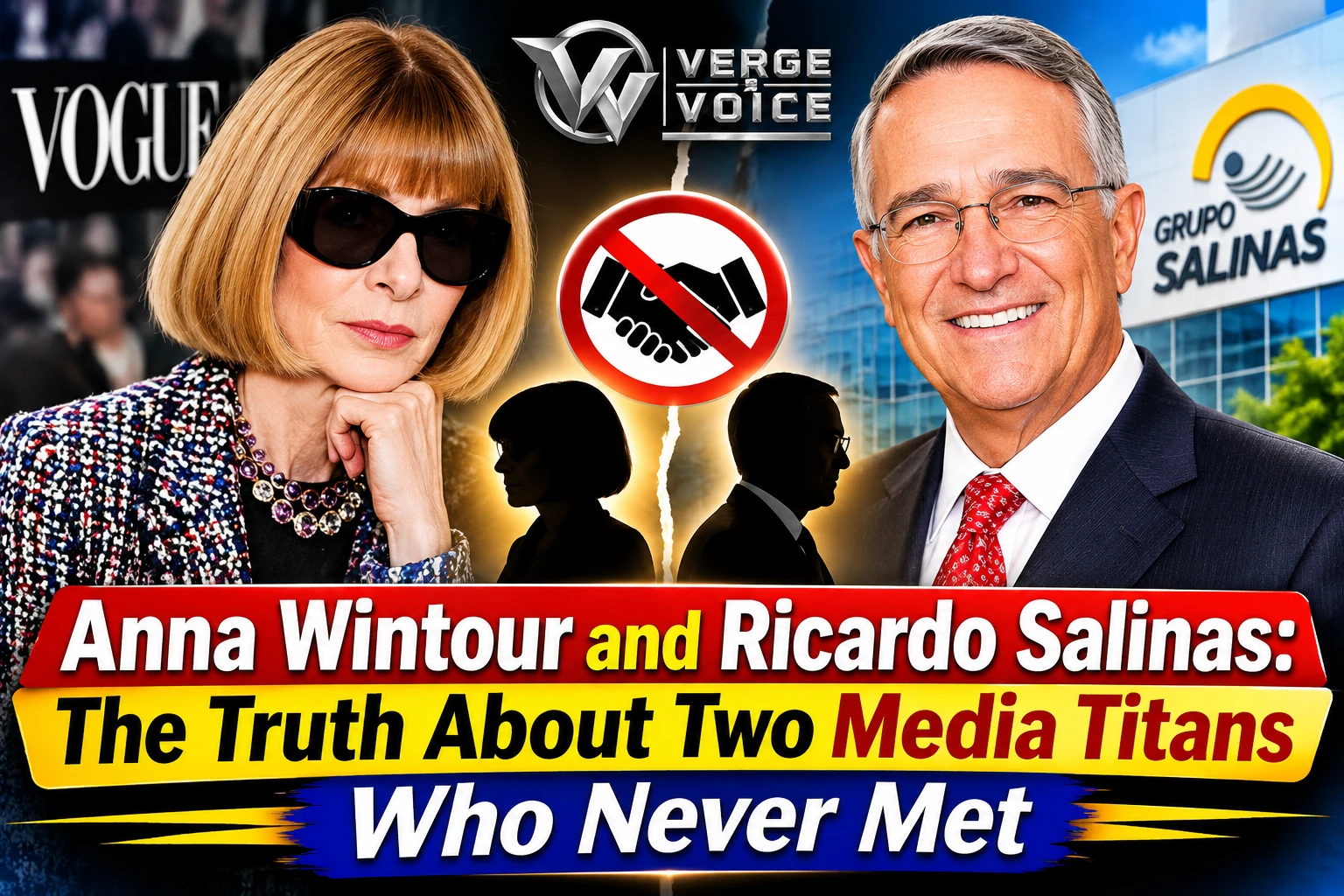
There is no known business relationship, collaboration, or personal connection between Anna Wintour and Ricardo Salinas Pliego. The association exists almost entirely in the minds of readers and analysts who compare them because they are two of the longest-reigning, most controlling, and most controversial media figures of the last four decades, one shaping global fashion from New York, the other shaping Mexican television and retail from Mexico City .
Why This Comparison Exists
If you search for “Anna Wintour and Ricardo Salinas” together, you are likely looking for a connection that simply does not exist in any corporate filing, court document, or credible news report. They have never co-chaired an event. They have never invested in the same company. They do not share a publicist, a political party, or a continent.
What they do share is a structural role: both built and maintained personal control over institutions that decide what millions of people see, buy, and talk about. And in 2026, both are facing the twilight of that control in very different ways.
This article separates the speculation from the record. It examines what is actually known about each figure, why readers conflate them, and what their current challenges reveal about the fragility of media power in the 2020s.
The Quick Facts
| Category | Anna Wintour | Ricardo Salinas Pliego |
|---|---|---|
| Born | November 3, 1949 (London, UK) | October 19, 1955 (Mexico City, Mexico) |
| Primary Power Base | Condé Nast / Vogue | Grupo Salinas (TV Azteca, Elektra, Banco Azteca) |
| Years in Control | Since 1988 (American Vogue) | Since 1987 (Grupo Elektra) |
| Signature Asset | The Met Gala (Chair since 1995) | TV Azteca (Acquired 1993) |
| 2026 Status | Global Chief Content Officer; ceded daily Vogue US control to Chloe Malle | Facing TV Azteca bankruptcy proceedings and a massive tax settlement |
Anna Wintour: The Institution Behind the Sunglasses
Anna Wintour’s power has never been about money in the way Salinas’s is. It is about access and validation. When she placed a young model in a pair of jeans on her first American Vogue cover in 1988, she signaled that high fashion could be democratic, or at least look democratic . That instinct—to translate exclusivity into mass relevance—made her indispensable to Condé Nast.
Her operational genius is the Met Gala. Since taking over as chair in 1995, she transformed a local costume institute fundraiser into a global spectacle that has raised more than $300 million for the Metropolitan Museum of Art’s Costume Institute . She personally approves every outfit and controls the guest list and seating chart with a level of detail that borders on the autocratic . This is not a hobby. It is the annual proof that she remains the single most powerful individual in the fashion-media complex.
The 2025–2026 Transition: The crucial development for anyone tracking Wintour is that she is no longer the daily editor of American Vogue. In mid-2025, she announced that the magazine would seek a new “Head of Editorial Content,” a role eventually filled by Chloe Malle . Wintour retains the titles of Chief Content Officer for Condé Nast and Global Editorial Director of Vogue, meaning she oversees Wired, Vanity Fair, GQ, and other titles . But she has consciously stepped back from the grind of monthly magazine production.
Why does this matter? Because it reveals that Wintour’s power was never really about editing pages. It was about being Anna Wintour. She remains the chair of the Met Gala, the face of Vogue World (which traveled to Milan in 2026), and the global ambassador for Condé Nast’s brand . The institution has been designed to outlast her daily involvement.
Ricardo Salinas Pliego: The Empire Under Siege
If Wintour’s power is cultural, Salinas’s is infrastructural. He controls the pipes through which millions of Mexicans receive news, entertainment, credit, and appliances. Grupo Elektra, founded by his great-grandfather, became a retail powerhouse under his control starting in 1987 . TV Azteca, which he acquired in a government auction in 1993, gave him a national megaphone . Banco Azteca, launched in 2002, brought banking to millions of unbanked Mexicans, often at interest rates that consumer advocates criticized .
For decades, this combination made him untouchable. He was the counterweight to Televisa’s media dominance, a billionaire who could move markets and shape public opinion with a single tweet or a prime-time editorial.
2026: The Year the Walls Closed In
The current reality for Salinas is stark. In early 2026, after years of litigation, his group agreed to settle a tax dispute with Mexico’s SAT (tax authority) over an amount initially assessed at 51 billion pesos . President Claudia Sheinbaum confirmed that Grupo Salinas had presented a payment intention, with potential legal discounts of up to 39% on fines and surcharges .
Simultaneously, TV Azteca entered a voluntary commercial bankruptcy (concurso mercantil) in 2026. A Mexico City judge formally declared the company in bankruptcy proceedings in July, revealing accumulated debts of 23,345 million pesos across 1,970 creditors—a 147% increase in liabilities since 2022 . The broadcaster continues to operate under judicial supervision, but its financial autonomy is severely constrained .
Salinas has responded with characteristic defiance. In November 2026, he publicly threatened to replace 15,000 bank tellers at Banco Azteca with machines, explicitly citing the cost of labor protections like maternity leave and unions . He called minimum wage increases and the proposed 40-hour workweek “an incredible stupidity” . These statements were not gaffes; they were strategic signals to a political establishment he openly despises. He has also hinted at a 2030 presidential run, telling the Financial Times that he would enter the race “if there is no alternative for me” .
The Real Common Ground: Control, Longevity, and Contempt for the Middleman
The reason readers link Wintour and Salinas is not conspiracy. It is pattern recognition.
Both figures disintermediated their industries. Wintour bypassed the traditional hierarchy of fashion publicity by making Vogue, and later the Met Gala, the singular gatekeeper for designer relevance and celebrity image-making. Salinas bypassed the traditional Mexican business elite by building a vertically integrated empire that lent money to the same working-class customers who bought his appliances and watched his television channels .
Both have also demonstrated a striking indifference to external criticism. Wintour’s reputation as an icy, exacting boss—cemented by The Devil Wears Prada—has never threatened her position; she has even leaned into the joke, appearing with Anne Hathaway at the 2026 Oscars in a playful reference to the film . Salinas, meanwhile, routinely attacks Mexico’s political class as “corrupt” and “incapable” while facing his own legal and financial battles .
And both are now navigating a transition away from the absolute control they once enjoyed. Wintour has delegated editorial authority while retaining symbolic and strategic power. Salinas is fighting to retain operational control of TV Azteca while a judge and a conciliator oversee his company’s finances .
What the Record Actually Shows (And What It Doesn’t)
Verified: Anna Wintour and Ricardo Salinas have never announced a partnership. No credible source reports a meeting, a joint venture, or a shared investment. The comparison is analytical, not relational .
Verified: Both are approaching or past standard retirement age (Wintour is 76; Salinas is 70) and remain actively involved in their empires, albeit in evolved roles .
Verified: Both face institutional pressure. Wintour’s pressure is reputational and structural—proving that Condé Nast can thrive as she steps back from daily editing. Salinas’s pressure is legal and financial—the tax settlement, the bankruptcy, and the bondholder litigation in U.S. courts that the Mexican bankruptcy shield does not fully protect against .
Unverified/False: Any claim that they have collaborated, that Wintour has advised Salinas on media strategy, or that Salinas has invested in Condé Nast or Vogue. There is no evidence for any of this.
Key Takeaways
- No Business Connection: Anna Wintour and Ricardo Salinas Pliego are not partners, collaborators, or business associates. The comparison stems from their parallel roles as long-reigning media gatekeepers.
- Different Kinds of Power: Wintour wields cultural capital (taste, access, validation). Salinas wields infrastructural capital (broadcast spectrum, retail credit, banking).
- 2026 Is a Transition Year for Both: Wintour has ceded daily editorial control of Vogue US while retaining global oversight and the Met Gala. Salinas is managing a tax settlement and a formal bankruptcy proceeding for TV Azteca.
- Salinas Is Escalating His Political Rhetoric: His threats to automate bank jobs and his hints at a 2030 presidential run signal a shift from business mogul to political actor.
- The Comparison Is Useful, Not Literal: Studying them together reveals how personal control over media institutions works—and how fragile that control becomes when the founder’s era ends.
Frequently Asked Questions
Are Anna Wintour and Ricardo Salinas friends?
There is no public evidence of a friendship or personal relationship. They operate in entirely different countries and industries.
Did Ricardo Salinas invest in Vogue or Condé Nast?
No. Condé Nast is privately held by Advance Publications (the Newhouse family). Salinas has no known stake.
Who is more powerful?
It depends on the metric. Wintour influences what the global elite wear and discuss. Salinas influences what millions of Mexicans watch, buy, and borrow. Neither power is absolute, and both are being tested in 2026.
Is TV Azteca going bankrupt?
TV Azteca has entered a concurso mercantil (commercial bankruptcy) proceeding. It is operating under judicial supervision while attempting to restructure its debts. A final liquidation has not occurred, but the process is ongoing .
Will Salinas run for president of Mexico?
He has said he will enter the 2030 race “if there is no alternative for me.” He is actively building a political movement and has positioned himself as a fierce critic of the current government. It is a credible threat, not a confirmed candidacy .
The Deeper Lesson
The compulsion to compare Anna Wintour and Ricardo Salinas reveals something about how we understand power in the media age. We want narratives of rivalry or alliance because they are simpler than the truth: that power is often parallel, isolated, and lonely at the top.
Wintour built a temple to taste. Salinas built a machine for attention and credit. Both temples are now showing their age. The question for the next decade is not whether they know each other, they don’t, but whether the institutions they built can survive without them in the room every day.
For Wintour, the answer appears to be yes, cautiously. For Salinas, the answer will be decided not by magazine covers or red carpets, but by judges, creditors, and voters he has spent years antagonizing