
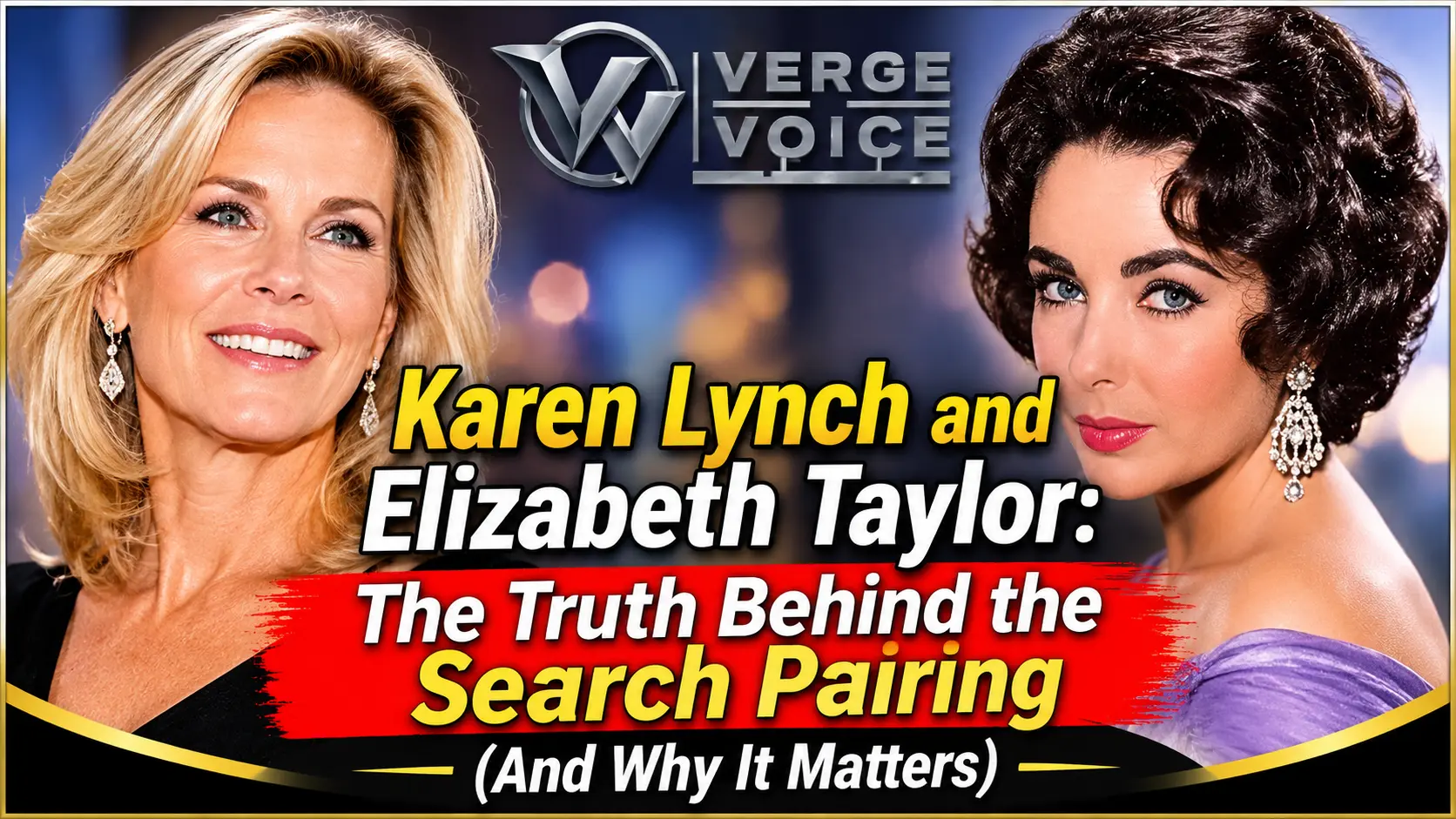
There is no real connection between Karen Lynch and Elizabeth Taylor. No family tie, no business deal, no secret friendship, and no documented meeting exists between the former CVS Health CEO and the Hollywood legend. The pairing appears in search results because of algorithmic side-by-side comparison pages, not because of any shared history. What does exist is something more interesting: two women who reached the absolute peak of male-dominated industries—healthcare and Hollywood—decades apart, and the internet has flattened their stories into a curiosity click. This article separates the noise from the substance, with verified facts, original analysis, and the context that comparison mills leave out.
Key Takeaways
- No connection exists. Karen Lynch and Elizabeth Taylor never worked together, never appeared in public records together, and shared no family or business ties .
- Karen Lynch is the former President and CEO of CVS Health (2021–2024), the first woman to run a Fortune 10 company, and a three-time Fortune Most Powerful Women leader .
- Elizabeth Taylor was a two-time Oscar winner, the defining face of classic Hollywood, and a pioneering AIDS activist who co-founded amfAR and raised hundreds of millions for research .
- The search pairing is an algorithmic artifact. Low-quality comparison sites generate side-by-side pages about unrelated famous names, and search engines begin suggesting the pairing .
- The real story is about two women who broke barriers in completely separate arenas—and what that says about how we search for connection in the digital age.
The Direct Answer: Are Karen Lynch and Elizabeth Taylor Related?
No. There is no family relationship, marriage, business partnership, or shared project between Karen Lynch and Elizabeth Taylor. Multiple sources that have investigated the pairing confirm this plainly. As one analysis puts it: “There is no verifiable connection between Karen Lynch and Elizabeth Taylor. No family relationship, business partnership, shared project, or documented public meeting exists between the healthcare executive and the Hollywood legend” .
Another investigation reached the same conclusion: “There is no family tie, no marriage, and no business connection between Karen Lynch and Elizabeth Taylor. The pairing exists in search queries, not in real life” .
So why does this search exist? The answer is less mysterious than it seems. Comparison-style websites publish side-by-side articles about celebrities and public figures with nothing in common, and once enough of those pages exist, search engines begin suggesting the pairing to curious users . People click. The cycle sustains itself. Add in the fact that “Karen Lynch” is not a unique name—other public figures share it, and the search results get muddier still .
But here’s the thing: the lack of connection doesn’t mean the comparison is worthless. It just means the valuable comparison isn’t the one the search engines are selling. The real parallel is about two women who each conquered an industry that was not built for them—and did it in radically different eras, with radically different consequences.
Who Is Karen Lynch? The Healthcare Executive Who Ran a Fortune 10 Company
Karen S. Lynch was born on December 30, 1963, in Ware, Massachusetts . She began her career as a certified public accountant at Ernst & Young, then moved through leadership roles at Cigna and Magellan Health Services before joining Aetna . At Aetna, she became the company’s first female president in 2015, reporting directly to then-CEO Mark Bertolini .
Her ascent to the top of CVS Health came after the company acquired Aetna in 2018 for approximately $70 billion . On February 1, 2021, Lynch became President and CEO of CVS Health, making her, at the time, the highest-ranking female CEO in Fortune 500 history by revenue . Fortune named her the top-ranking leader on its Most Powerful Women in Business list for three consecutive years, and in 2023 she was selected for the TIME100 annual list of the hundred most influential people in the world .
Her tenure at CVS was not without turbulence. She stepped down in October 2024 amid rising medical costs in the company’s insurance business and weak drugstore sales, with CVS shares down 19% for the year at the time of the announcement . Fortune later reported that her exit left the Fortune 10 without a single woman-led company for the first time in years, a detail that underscores how rare her run at the top really was .
In a September 2025 interview with Fortune, Lynch reflected on the transition: “When you step out of the CEO chair, it’s incredibly quiet. You go from having a lifetime of scheduled 15-minute, 30-minute blocks to suddenly, there’s so much space in your day” . Since leaving CVS, she has served on boards, supported firms through CEO succession, and established a leadership institute .
The takeaway: Karen Lynch’s story is one of incremental institutional mastery, accounting, insurance, managed care, then the top job at a healthcare giant. She didn’t become famous. She became powerful. And then she left, quietly, into a portfolio career that most business media ignored.
Who Was Elizabeth Taylor? The Star Who Became Something More
Elizabeth Rosemond Taylor was born in London on February 27, 1932, to American parents. She moved to Los Angeles with her family in 1939 and was soon discovered at her father’s art gallery . She debuted in 1942 and became a child star with National Velvet in 1944 .
Her film career peaked in the 1950s and 1960s with four consecutive Oscar nominations from 1958 to 1961. She won her first Best Actress Oscar for Butterfield 8 in 1960, a win widely believed to have been fueled by sympathy after a near-fatal bout of pneumonia in London that nearly killed her . She won her second Oscar for Who’s Afraid of Virginia Woolf? in 1966, opposite Richard Burton, to whom she was married twice .
But Taylor’s most consequential legacy may not be on film. After her friend Rock Hudson died of AIDS in 1985, she became one of the first major celebrities to publicly fight for AIDS research funding and to dispel the stigma surrounding the disease . She co-founded amfAR (the Foundation for AIDS Research) and established the Elizabeth Taylor AIDS Foundation in 1991 . When she died on March 23, 2011, at age 79 from congestive heart failure, tributes focused as much on her activism as her film career .
Her personal life was famously chaotic, eight marriages to seven men, including Conrad Hilton, Michael Wilding, Mike Todd, Eddie Fisher, Richard Burton (twice), John Warner, and Larry Fortensky . She was equally famous for her glamour, her jewelry, and her unwavering loyalty to friends like Michael Jackson, whose funeral she attended in 2009 despite her failing health .
The takeaway: Elizabeth Taylor’s story is one of reinvention at scale. She was a child star, a sex symbol, a serious actress, a tabloid fixture, and finally a humanitarian whose advocacy changed the trajectory of a global epidemic. She was famous in a way that no longer exists—and she used that fame for something that outlasted her.
The Comparison Table: Two Careers, One Algorithm
| Detail | Karen Lynch | Elizabeth Taylor |
|---|---|---|
| Born | December 30, 1963, Ware, Massachusetts | February 27, 1932, London, England |
| Died | Living | March 23, 2011, Los Angeles (age 79) |
| Field | Healthcare, insurance, pharmacy | Film, philanthropy, fragrance |
| Peak Role | President & CEO, CVS Health (2021–2024) | Two-time Academy Award winner; AIDS activist |
| Signature Achievement | First woman to lead a Fortune 10 company by revenue | Co-founded amfAR; Jean Hersholt Humanitarian Award (1993) |
| Recognition | Fortune Most Powerful Women (#1, three years); TIME100 (2023) | Two Oscars; BAFTA Fellowship; AFI Life Achievement Award |
| Public Profile | Corporate, low-profile, boardrooms | Global celebrity, tabloid fixture, cultural icon |
| Connection to Each Other | None documented | None documented |
Why the Search Pairing Exists (And Why It’s Not Entirely Useless)
Let’s be honest about the mechanics. The “Karen Lynch and Elizabeth Taylor” search exists because of a content ecosystem that profits from curiosity gaps. Sites publish side-by-side articles about unrelated famous people. Search engines index them. Users see the suggestion, click, and the cycle continues .
But there’s a second-order effect that’s worth acknowledging. When people search for this pairing, many are not actually looking for a secret connection. They’re looking for one of these women and encountered the other’s name in the same search result. A reader who searched “Karen Lynch CVS” might see Elizabeth Taylor’s name and wonder, briefly, if there’s something they missed. A reader who searched “Elizabeth Taylor AIDS” might see Karen Lynch and wonder the same.
The comparison articles that dominate this search query are mostly thin, repetitive, and optimized for the algorithm rather than the reader. They answer the “are they related” question in a sentence, then pad the rest with generic biographies. They don’t tell you why these two names persist together in search results, and they don’t give you anything useful about either woman that you couldn’t find on Wikipedia.
This article is an attempt to do something different. The connection is nothing. The comparison, however, is worth making—not because these women are alike, but because they represent two distinct models of female power in the 20th and 21st centuries.
What Their Stories Actually Tell Us About Women, Power, and Legacy
Karen Lynch and Elizabeth Taylor are not connected. But they are comparable in a way that the comparison mills never explore. Both reached the summit of industries that were structurally hostile to women. Both did so by mastering the rules of their respective games, Lynch through operational excellence and institutional loyalty, Taylor through sheer star power and emotional intelligence. And both exited the public eye on their own terms, more or less.
Lynch’s model of power was institutional. She rose through the ranks of large healthcare corporations, each step building on the last. Her authority came from her position: CEO of CVS Health, President of Aetna. When she left the CEO chair, the authority transferred to her successor. She retained influence through boards and mentorship, but the institutional power was gone. This is the model of power that most women in corporate America are taught to pursue: earn the title, hold the title, use the title.
Taylor’s model of power was personal. Her authority came from her presence, on screen, in the tabloids, in the room. She had no institutional title that conveyed power. She was an actress, a celebrity, a humanitarian. Her influence derived from her ability to command attention and direct it toward causes she cared about. When she died, the power didn’t transfer. It simply ended, leaving behind the institutions she had built and the people she had inspired.
Neither model is superior. But the contrast is revealing. Lynch operated in a world where power is granted by structures and revoked by boards. Taylor operated in a world where power is granted by audiences and revoked by time. Lynch’s legacy will be measured in corporate history and boardroom diversity statistics. Taylor’s legacy is measured in lives saved from AIDS and in the cultural memory of a woman who refused to be contained by the roles she was given.
My analysis: The reason this pairing feels almost meaningful, even though it isn’t, is that both women represent something we’re still figuring out: what it looks like when a woman reaches the top and what she does with that position. Lynch’s quiet exit from CVS was reported as a business story. Taylor’s death was a global event. Neither woman was primarily defined by her connection to men, though both had complicated personal lives. Both were, in their own ways, relentlessly themselves.
The One Moment When Their Worlds Almost Touched (But Didn’t)
Here’s a detail worth knowing, if only to satisfy the curiosity that brought you here.
Elizabeth Taylor’s near-fatal pneumonia in 1961 happened while she was in London filming Cleopatra. The New York Times reported on March 6, 1961, that she had undergone a tracheotomy and was “not out of danger as yet” . The crisis was so severe that a rumor of her death spread globally within hours . She survived, won an Oscar that year in what many believed was a sympathy vote, and went on to make Cleopatra, the film that introduced her to Richard Burton and cemented her as the most talked-about woman in the world .
Karen Lynch was not born until 1963. She was a toddler when Taylor was at the peak of her tabloid fame. By the time Lynch entered the corporate world in the 1980s, Taylor had already transitioned from movie star to AIDS activist. Their timelines overlap, but their worlds never intersected. Lynch was building a career in insurance and managed care. Taylor was testifying before Congress and raising money for research.
The only “connection” is chronological coincidence. And that’s fine. Not every pairing needs a plot twist.
Frequently Asked Questions
Are Karen Lynch and Elizabeth Taylor related?
No. There is no family relationship between them. They share no known ancestors, no marriage ties, and no documented personal connection .
Did Karen Lynch and Elizabeth Taylor ever meet?
There is no public record of them meeting. Their careers took place in different industries and largely different decades. No interview, photograph, or credible report documents a meeting .
Why do people search for Karen Lynch and Elizabeth Taylor together?
The pairing is an algorithmic artifact. Comparison websites publish side-by-side pages about unrelated public figures, and search engines begin suggesting the pairing to users. “Karen Lynch” is also a common name, which adds to the confusion .
Who is Karen Lynch?
Karen S. Lynch is the former President and CEO of CVS Health (2021–2024). She was the first woman to lead a Fortune 10 company by revenue and was named Fortune’s Most Powerful Woman in Business three times .
Who was Elizabeth Taylor?
Elizabeth Taylor was a British-American actress and two-time Academy Award winner who became one of the most famous women of the 20th century. In her later years, she was a pioneering AIDS activist and co-founded amfAR .
Is there any business connection between CVS and Elizabeth Taylor?
No. CVS Health has no documented business relationship with Elizabeth Taylor or her estate. The only tenuous connection is that Taylor’s AIDS foundation has received funding from numerous corporate donors over the decades, but there is no evidence CVS was among them.
Final Thoughts: The Curiosity Gap Is Real, But the Truth Is Better
The search for “Karen Lynch and Elizabeth Taylor” is a case study in how the internet manufactures connections that don’t exist. Two names appear together in a search suggestion. A few dozen low-quality pages repeat the same non-answer. The curiosity gap sustains itself.
But here’s what the algorithm misses: Karen Lynch and Elizabeth Taylor don’t need a connection to be worth knowing about. Lynch ran the largest healthcare company in America and then walked away. Taylor survived a near-death experience, won two Oscars, and spent the last 25 years of her life fighting an epidemic that the world wanted to ignore. Neither woman needed the other to be remarkable.
If you came here looking for a secret family tree or a hidden business deal, you didn’t find it. But you did find two stories that are worth more than the click that brought you here. That’s the trade-off. The connection is nothing. The women are everything.