
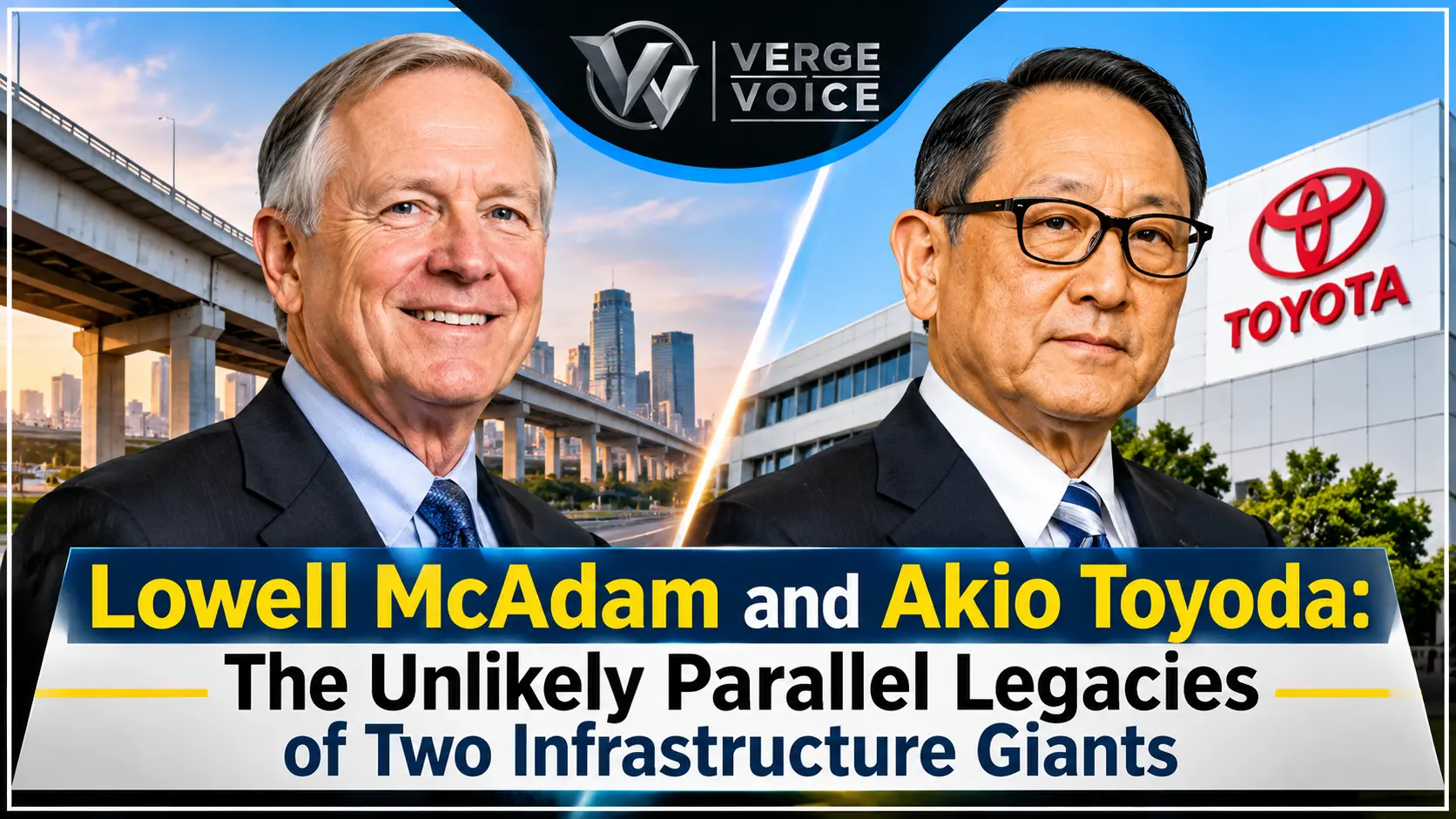
Direct Answer: What Connects Lowell McAdam and Akio Toyoda?
There is no direct business partnership, joint venture, or personal relationship between Lowell McAdam and Akio Toyoda. They led completely separate industries, American wireless telecommunications and Japanese automotive manufacturing, during overlapping periods of enormous pressure. The genuine connection lies in a shared leadership archetype: both were operational engineers who inherited institutions in crisis or transition, both made massive structural bets on control, and both eventually handed power to younger successors while remaining as elder statesmen. McAdam ran Verizon from 2011 to 2018, betting on full ownership of Verizon Wireless through a $130 billion Vodafone buyout. Toyoda became Toyota’s president in 2009 amid financial collapse and a devastating recall crisis, then spent fourteen years rebuilding the company’s culture before ceding the CEO role to Koji Sato in 2023. Their stories are not intertwined, but they rhyme.
Key Takeaways
| Insight | Lowell McAdam | Akio Toyoda |
|---|---|---|
| Crisis inherited | Fragmented wireless ownership; needed full control of Verizon Wireless | Global financial crisis; unintended acceleration recall scandal |
| Signature strategic move | $130 billion Vodafone buyout (2014) | “Ever-better cars” cultural rebuild; hybrid-first electrification strategy |
| Succession style | Chose CTO Hans Vestberg, an outsider to Verizon tradition | Chose Koji Sato, a Lexus and racing engineer, as younger change agent |
| Post-CEO role | Executive chairman, then non-executive chairman until 2019 | Chairman of the board since 2023, still visibly influential |
| Defining vulnerability | Media acquisitions (AOL, Yahoo) largely failed | Perceived slowness on battery electric vehicles |
The Engineer and the Heir: Two Paths to the Same Pressure Cooker
Lowell McAdam was never supposed to be a household name. Born in 1954, he trained as an engineer at Cornell University, spent six years in the U.S. Navy’s Civil Engineer Corps, and became a licensed professional engineer in 1979. His ascent through the telecom world was methodical: Pacific Bell in the 1980s, AirTouch International in the 1990s, then PrimeCo a joint venture that built one of America’s first all-digital mobile networks. When Verizon Wireless formed in 2000, McAdam was already inside the machine, serving as COO and later CEO of the wireless division before moving to the parent company in 2010.
Akio Toyoda’s path looked like nepotism from the outside and felt like probation from the inside. Born in 1956, the grandson of founder Kiichiro Toyoda studied law at Keio University, then earned an MBA at Babson College in Massachusetts. He joined Toyota in 1984 and spent the next twenty-five years in production, sales, international operations, and the NUMMI joint venture with General Motors in California. When he became president in June 2009, he inherited a company reeling from the global financial crisis, Toyota posted its first operating loss in decades, and within months faced the unintended acceleration recall crisis that culminated in his testimony before the U.S. Congress in February 2010.
The parallel is precise: both men took control of sprawling infrastructure businesses at moments when the existing operating model was no longer sufficient. McAdam’s problem was structural ownership. Toyoda’s problem was cultural credibility.
The $130 Billion Bet: McAdam’s Case for Absolute Control
McAdam’s defining decision as Verizon CEO was not a product launch or a marketing campaign. It was a balance sheet move that reshaped the American wireless industry.
For years, Verizon Wireless operated as a joint venture between Verizon Communications (55%) and Vodafone (45%). That structure constrained Verizon’s ability to invest aggressively, return capital efficiently, and make long-term strategic decisions without a European partner’s consent. In 2014, McAdam engineered the purchase of Vodafone’s 45 percent stake for approximately $130 billion, one of the largest corporate transactions in history.
Why this mattered beyond the headline number: Full ownership gave Verizon complete control over its most profitable asset at the exact moment mobile data was becoming the center of gravity for consumer technology. McAdam then pushed Verizon into 4G LTE deployment and early 5G development, arguing that network quality was the company’s irreducible competitive advantage. He also made a smaller but telling bet on media, buying AOL in 2015 and Yahoo’s core internet assets in 2017, attempting to build an advertising and content layer on top of the pipe. That bet largely failed, and the assets were later sold. McAdam’s tenure thus offers a clean case study in strategic discipline and strategic overreach: the Vodafone buyout was transformative; the media acquisitions were a distraction dressed as diversification.
The Heir Who Had to Earn It: Toyoda’s Cultural Reconstruction
Akio Toyoda’s inheritance was more complicated than a balance sheet. Toyota’s reputation in 2009–2010 was not just bruised; it was existentially threatened. The recall crisis involved millions of vehicles and allegations that Toyota had prioritized growth over safety. When Toyoda testified before Congress, he did something unusual for a Japanese executive: he apologized directly, publicly, and repeatedly.
What followed was a long, deliberate cultural rebuild. Toyoda pushed authority back toward regional managers and engineers. He championed the slogan “ever-better cars,” a deliberately unglamorous phrase that signaled a return to product fundamentals rather than quarterly earnings optics. He also became a racing driver under the pseudonym “Morizo,” using motorsport as a testing ground for engineers and a symbolic break from Toyota’s cautious corporate identity.
On electrification, Toyoda’s record is more contested. Toyota pioneered the Prius hybrid and sold millions of them, but the company was slower than rivals, and dramatically slower than Tesla, to embrace battery electric vehicles. Toyoda argued that hybrids and plug-in hybrids made more sense for markets without charging infrastructure, a position that frustrated activists and some investors but reflected his engineering pragmatism and a genuine concern about resource constraints. When he stepped down as CEO in 2023, he acknowledged that he had become “part of an older generation” on electrification and connectivity.
Succession as a Final Strategic Act
The most revealing comparison between McAdam and Toyoda may be how each chose to leave.
McAdam announced his retirement in June 2018, handing the CEO role to Hans Vestberg, Verizon’s chief technology officer and a former Ericsson CEO. Vestberg was an outsider to Verizon’s long corporate tradition, a signal that McAdam believed the next era required a different kind of leader, one focused on 5G and network architecture rather than the deal-making and wireless operations that defined his own rise.
Toyoda’s handover was more theatrical and more carefully staged. In January 2023, Toyota announced that Koji Sato, then chief branding officer and head of Lexus, would become president and CEO on April 1, with Toyoda moving to chairman. The announcement was a surprise to analysts. Koji Endo of SBI Securities noted that “ten out of ten analysts had probably been thinking that Toyoda would carry on,” and described Sato’s early years as an “apprenticeship” under the old master. Toyoda remained a representative director and made clear he would stay involved. The message was calibrated: change at the top, continuity in the soul.
Both successions share a logic that is easy to miss. McAdam and Toyoda each recognized that the next phase of their institution’s life required skills they did not personally embody. McAdam built Verizon’s wireless dominance through ownership and scale; he chose a technologist for the network era. Toyoda rebuilt Toyota’s culture through personal credibility and product passion; he chose a younger engineer for the mobility transition. Neither man truly let go, both remained as chairmen, but both formalized the transfer of daily authority.
What These Two Leaders Reveal About Infrastructure Leadership
The Lowell McAdam and Akio Toyoda comparison matters not because they crossed paths, but because they represent a specific and underappreciated category of leader: the operator who inherits a complex infrastructure institution and must decide what to control, what to fix, and when to step aside.
McAdam’s lesson is about structural clarity. The Vodafone buyout was not glamorous, but it removed a permanent governance friction that had constrained Verizon for over a decade. Infrastructure businesses often suffer from ownership ambiguity, and McAdam’s willingness to pay a massive price for clarity, rather than pursue a splashier acquisition,was a mature strategic choice. His media detour is the counter-lesson: even excellent operators can convince themselves that adjacency is synergy when it is not.
Toyoda’s lesson is about cultural legitimacy. He could have governed from the family name alone. Instead, he spent his early years apologizing, listening, and visibly changing Toyota’s product priorities. His “Morizo” persona was not a midlife crisis; it was a communication strategy designed to signal that engineering excellence mattered more than corporate caution. The electrification criticism he faced is legitimate, but it does not erase the fact that he stabilized a company that was genuinely in crisis in 2009–2010.
The most useful takeaway for anyone leading a large, complex organization is this: both men understood that their primary job was not to be the smartest person in the room, but to make the institution’s next decision easier. McAdam did that by buying out a partner. Toyoda did it by rebuilding trust and then handing the keys to an engineer who had earned his respect. Neither legacy is flawless. Both are instructive.
Frequently Asked Questions
Did Lowell McAdam and Akio Toyoda ever work together?
No. There is no record of any joint venture, partnership, or professional collaboration between Lowell McAdam and Akio Toyoda. McAdam led Verizon Communications in the United States; Toyoda led Toyota Motor Corporation in Japan. Their careers overlapped in time, McAdam as Verizon CEO from 2011 to 2018, Toyoda as Toyota president from 2009 to 2023, but not in business relationship.
Who is Lowell McAdam?
Lowell Clayton McAdam is an American engineer and former telecommunications executive. He served as CEO of Verizon Communications from August 2011 to August 2018 and as chairman from January 2012 until 2019. His most significant strategic move was the 2014 purchase of Vodafone’s 45 percent stake in Verizon Wireless for approximately $130 billion, giving Verizon full ownership of its wireless business.
Who is Akio Toyoda?
Akio Toyoda is the grandson of Toyota founder Kiichiro Toyoda. He served as president and CEO of Toyota Motor Corporation from June 2009 until April 2023, when he became chairman of the board. He led Toyota through the global financial crisis, the 2009–2010 recall crisis, and the early transition toward electrified and autonomous vehicles. He is also a racing driver who competes under the name “Morizo”.
Why did Akio Toyoda step down as CEO?
Toyoda said he felt he had become “part of an older generation” regarding electrification and connectivity challenges, and that a younger leader could better drive Toyota’s transformation into a “mobility company.” He became chairman and was succeeded by Koji Sato, formerly the head of Lexus and Toyota’s chief branding officer.
What was Lowell McAdam’s biggest failure at Verizon?
McAdam’s media strategy is widely viewed as his weakest strategic bet. Verizon acquired AOL in 2015 and Yahoo’s core internet business in 2017, attempting to build a digital advertising and content business. These assets never performed as hoped and were eventually sold or wound down by his successor, Hans Vestberg.
Final Analysis: Why Their Stories Still Matter
The search for a direct link between Lowell McAdam and Akio Toyoda yields nothing because there is nothing to find. But the search for meaning in their parallel careers yields something more valuable: a template for understanding how infrastructure leaders operate under pressure.
McAdam believed that control, full ownership, clear decision rights, was the precondition for long-term investment. Toyoda believed that credibility, earned through apology, presence, and product obsession, was the precondition for cultural change. Both were right about their own institutions. Both also discovered the limits of their approaches: McAdam could buy control but could not buy a successful media business; Toyoda could rebuild trust but could not single-handedly dictate the pace of the electric transition.
Their legacies are not monuments. They are case studies. And for anyone leading an organization through a transition that feels larger than any single person can manage, the most useful thing McAdam and Toyoda offer is proof that the job is not about being irreplaceable. It is about making the next decision, and the next leader, possible.