
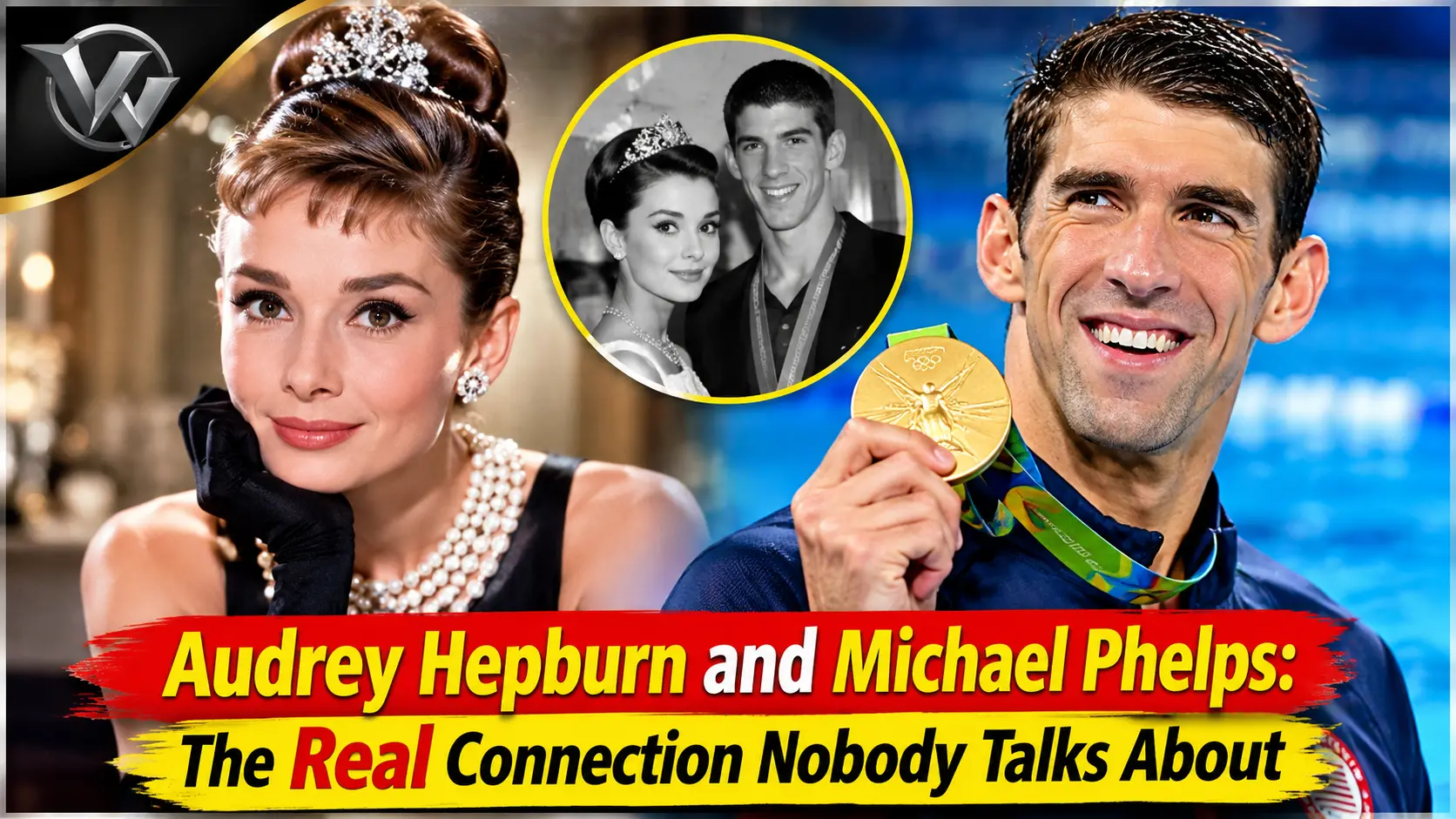
There is no family tie, no secret friendship, and no professional collaboration between Audrey Hepburn and Michael Phelps. Hepburn died in January 1993, when Phelps was seven years old and had not yet swum on the Olympic stage. Yet the search for Audrey Hepburn and Michael Phelps persists because both figures represent something rarer than fame: the decision to convert personal pain into public purpose. This article separates verified fact from internet noise, examines the documented lives of both icons, and explains why their names keep appearing in the same sentence—even though their timelines barely overlapped.
Key Takeaways
The Timeline That Makes a Personal Link Impossible
Hepburn was born on May 4, 1929, in Ixelles, Brussels. Phelps was born on June 30, 1985, in Baltimore, Maryland. When Hepburn died on January 20, 1993, at her home in Switzerland, Phelps was a second-grader. He would not appear at an Olympic Games until Sydney 2000, seven years after her death.
This is not a minor detail. It is the entire answer to the relationship question. No reliable biography of Hepburn mentions Phelps. No verified interview with Phelps references a personal connection to Hepburn. The two existed in completely separate eras of public life. Hepburn’s Hollywood peak arrived in the 1950s and 1960s; Phelps’s athletic dominance unfolded between 2000 and 2016.
Any claim of a hidden friendship, a secret mentorship, or a family connection should be treated as fabrication unless accompanied by a primary source. None has surfaced in official biographies, institutional archives, or reputable interviews.
Who Was Audrey Hepburn, Beyond the Little Black Dress?
Hepburn’s story begins in privilege and unravels into wartime survival. Born to a Dutch baroness and an English banker, she spent part of her adolescence in the Netherlands under Nazi occupation. The Dutch famine of 1944–1945 left her malnourished, and she later learned that her ballet ambitions were physically impossible because of the damage to her body. Acting became the unexpected path.
Her breakthrough arrived with Roman Holiday in 1953. At 24, she won the Academy Award for Best Actress for her portrayal of a runaway princess. What followed was one of the most selective filmographies in Hollywood history: Sabrina (1954), Funny Face (1957), The Nun’s Story (1959), Breakfast at Tiffany’s (1961), Charade (1963), and My Fair Lady (1964). She did not make many films, but the ones she chose became permanent reference points for style, restraint, and a particular kind of screen intelligence that resisted easy categorization.
She was also one of the few performers to win competitive Emmy, Grammy, Oscar, and Tony awards—a distinction shared by only a handful of entertainers in history. But the awards tell only part of the story.
The UNICEF Chapter That Redefined Her Legacy
In 1988, Hepburn became a UNICEF Goodwill Ambassador. This was not a ceremonial title. Her first mission took her to Ethiopia, where drought and conflict had produced famine. She traveled to Somalia, Bangladesh, Vietnam, and several other countries, often visiting feeding centers and speaking to children whose circumstances she described in interviews with controlled but visible emotion.
She testified before the United States Congress about her experiences. She used her fame not to burnish her own image but to direct attention toward children who had no access to the platforms she occupied. When she died in 1993, her son Sean accepted a posthumous award at the Oscars in recognition of her humanitarian work. The Academy Award for Roman Holiday made her famous. The UNICEF work made her consequential.
Michael Phelps: The Most Decorated Olympian, and the Cost of That Title
Phelps’s athletic record is not in dispute and does not need embellishment. Across five Olympic Games—Sydney 2000, Athens 2004, Beijing 2008, London 2012, and Rio 2016—he won 28 medals, including 23 golds. At the Beijing Games alone, he won eight gold medals and set seven world records, an achievement without parallel in modern Olympic history.
Those numbers are extraordinary. They are also incomplete as a portrait.
What Phelps Has Said About Mental Health
In interviews and keynote addresses, Phelps has described a parallel experience that his medals concealed. “I didn’t want to be in the sport anymore,” he said at a mental health conference. “I didn’t want to be alive anymore”. He has spoken about falling into major depressive episodes after Olympic Games, about compartmentalizing emotions so effectively that he stopped perceiving himself as human, and about the moment he recognized he needed professional help.
His advocacy has focused on reducing stigma and encouraging men, in particular, to speak about depression and anxiety. He has worked with Talkspace and other mental health platforms, and he has been candid about the limitations of the sports system that produced him. In a 2026 interview on the Whoop Podcast, he said he does not want his four children to swim competitively because he does not want them to experience what he went through with USA Swimming.
“The guy that went out and won a couple gold medals and broke some world records,” he said, “I never saw myself as a human”.
The Real Link: Two Different Kinds of Consequence
If there is a legitimate reason to discuss Audrey Hepburn and Michael Phelps together, it lies in how each handled the aftermath of extreme visibility.
Hepburn’s turn toward UNICEF came after her film career had slowed. She could have retreated into private life in Switzerland. She chose instead to fly to famine zones and testify before legislators. Her fame became a tool for directing resources and attention toward children in crisis.
Phelps’s turn toward mental health advocacy came after the pool. He could have accepted the retirement narrative that awaited him: the most decorated Olympian, the family man, the elder statesman of American swimming. He chose instead to describe suicidal ideation, depression, and the feeling of being dehumanized by a system that treated him as a medal-producing machine.
Both decisions required a kind of courage that their respective fields did not demand. Hepburn was not required to visit Ethiopia. Phelps was not required to tell the world he had contemplated suicide. They did these things because their experiences had changed what they valued.
A Note on Comparison and Its Limits
It is tempting to draw a clean parallel: two icons, two causes, two legacies of service. But the comparison has limits. Hepburn’s humanitarian work was institutional, conducted through UNICEF, with a clear organizational mandate. Phelps’s advocacy is more personal and more contested, particularly in his criticism of USA Swimming and his claim that the organization shut him out when he tried to push for change. Hepburn worked within a system she respected. Phelps has publicly criticized the system that made him.
That difference matters. It suggests that the lesson is not that fame inevitably leads to philanthropy. The lesson is that individuals respond to their own histories in unpredictable ways. Hepburn’s wartime hunger and her later UNICEF work are connected by a thread of memory. Phelps’s depression and his advocacy are connected by the recognition that the machine that produced his medals also produced his suffering.
What the Search Results Get Wrong (and Why It Matters)
Several low-quality websites have published articles pairing Hepburn and Phelps with titles that imply a relationship, a shared net worth comparison, or a “connection” that does not exist. These pages often use the two names to generate clicks, then bury the answer—no connection—beneath paragraphs of filler.
One example: a site that ranks for the phrase “Audrey Hepburn and Michael Phelps” presents a net worth comparison between a living athlete and an actress who died in 1993, treating the figures as if they were equivalent. This is not useful information. It is content designed to occupy a search result.
A reader searching for Audrey Hepburn and Michael Phelps deserves a direct answer: they are not connected. The more interesting question is why we keep searching for connections between figures who occupy different eras and different domains. The answer may be that we are drawn to the idea of a shared thread—that greatness in one field might predict greatness in another, or that famous people secretly know each other. The reality is usually less dramatic and more human: two people, separated by time, who each found a reason to serve beyond themselves.
A Table of Verified Facts
Frequently Asked Questions
Did Audrey Hepburn ever meet Michael Phelps?
No. Hepburn died in 1993, when Phelps was seven years old. There is no record of a meeting, and no interview in which either mentions the other.
Are they related?
No. Their family backgrounds are entirely separate. Hepburn’s mother was a Dutch baroness; Phelps grew up in a middle-class family in Baltimore.
Why do people search for them together?
The pairing appears in trivia lists, “greatest icons” comparisons, and pop culture content that groups famous figures without regard for chronology. The search volume likely reflects curiosity about whether two very different kinds of greatness might intersect.
What did Hepburn do for UNICEF?
She traveled to Ethiopia, Somalia, and other countries, testified before Congress, and used her public platform to draw attention to children affected by famine and conflict.
What does Phelps say about mental health?
He has described depression, anxiety, and suicidal thoughts, and he advocates for open discussion and professional treatment. He has criticized USA Swimming for what he describes as a lack of athlete support.
The Legacy Question
What remains after the medals and the films? Hepburn’s films continue to be watched. Her UNICEF work continues to be cited as a model of celebrity engagement. Phelps’s records may eventually be broken—though the eight-gold Beijing performance is likely to stand for a very long time. His mental health advocacy, however, addresses a problem that does not have a finish line.
The Audrey Hepburn and Michael Phelps pairing is a search anomaly, not a historical relationship. But it points toward something real: the desire to understand how people who achieve extraordinary things in one arena decide what to do with the platform that follows. Hepburn chose children. Phelps chose the interior life. Neither choice was inevitable. Both were consequential.
If there is a takeaway from placing these two names side by side, it is this: the most important thing about a public figure is rarely the thing that made them famous. It is what they did when the spotlight moved, or when they realized the spotlight had been hiding something they needed to confront. Hepburn and Phelps are not connected by blood or friendship. They are connected by the decision to stop performing and start speaking.